
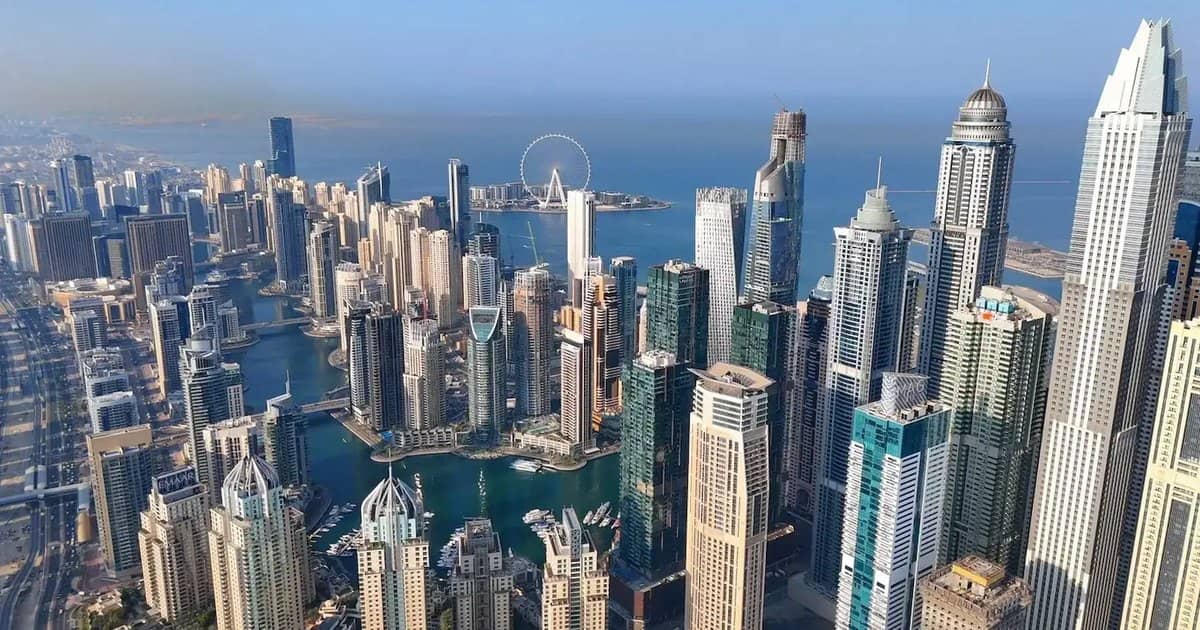
Quick answer: the Dubai property market enters 2027 slower and slightly cheaper than it was a year ago. The Dubai Land Department (DLD) registered 136,026 sales from January to October 2026, down 24% on the same ten months of 2025. The median price per square foot across all sales was AED 1,639 in October 2026, 10% below the April 2026 peak of AED 1,824, while the resale median (AED 1,554) was level with October 2025. Resales fell first and have been recovering since May; developer sales held up until April and were 45% lower in October than a year earlier. New launches have roughly halved, completions are running ahead of 2025 and rents on new leases have stopped rising. Whether prices fall further in 2027 turns on three things you can track yourself: deliveries, off-plan demand and rents.
This outlook is built only from transactions registered with the DLD, read on 23 November 2026 through the market-data feed Homesae uses. It contains no price target. Forecasts for Dubai have a poor record in both directions, so what follows is what the register shows today, how it compares with earlier cycles, and the indicators that will tell you which way 2027 is going before the headlines do. It replaces our October 2025 market report as Homesae’s current view.
Where does the Dubai property market stand going into 2027?
Three numbers describe the year. All compare January to October 2026 with January to October 2025, the last ten complete months on the register.
| Measure (January to October) | 2025 | 2026 | Change |
|---|---|---|---|
| Registered sales, all property types | 177,940 | 136,026 | -24% |
| Value of registered sales | AED 558 billion | AED 416 billion | -25% |
| Sales by developers (primary) | 122,213 | 95,561 | -22% |
| Resales | 55,727 | 40,465 | -27% |
| Median price per sq ft, all sales, October | AED 1,703 | AED 1,639 | -3.8% |
| Median price per sq ft, resales, October | AED 1,556 | AED 1,554 | -0.1% |
| Median price per sq ft, developer sales, October | AED 1,750 | AED 1,668 | -4.7% |
Source: DLD registered transactions via the market-data feed Homesae uses, read 23 November 2026. November is left out because the month is not complete.
The year did not start slowly. January and February 2026 were ahead of 2025 (34,407 sales against 30,261), and the median price per square foot was still setting records in April. The change came from March: the eight months from March to October registered 101,619 sales against 147,679 a year earlier, down 31%. March 2026 is also the month the regional conflict began, which we wrote about at the time in Dubai property prices after the Iran war. The register shows the timing. It does not show the cause, and we are not going to assign one.
How have Dubai property sales and prices moved month by month in 2026?
| Month | Sales 2025 | Sales 2026 | Change | Median AED per sq ft 2026, all sales | Median AED per sq ft 2026, resales |
|---|---|---|---|---|---|
| January | 14,212 | 17,295 | +22% | 1,816 | 1,557 |
| February | 16,049 | 17,112 | +7% | 1,788 | 1,645 |
| March | 15,154 | 13,539 | -11% | 1,799 | 1,597 |
| April | 17,942 | 14,074 | -22% | 1,824 | 1,555 |
| May | 18,659 | 10,298 | -45% | 1,655 | 1,558 |
| June | 16,717 | 14,107 | -16% | 1,695 | 1,566 |
| July | 20,283 | 14,243 | -30% | 1,691 | 1,490 |
| August | 18,749 | 12,081 | -36% | 1,689 | 1,513 |
| September | 20,319 | 11,340 | -44% | 1,656 | 1,517 |
| October | 19,856 | 11,937 | -40% | 1,639 | 1,554 |
Source: DLD registered transactions, read 23 November 2026.
Two things stand out. The all-sales median dropped sharply in a single month, from AED 1,824 in April to AED 1,655 in May, and has moved sideways since. The resale median did not: it has stayed between AED 1,490 and AED 1,645 all year. A one-month drop of that size in a median is mostly a change in what was sold rather than in what each home is worth. From May, a larger share of sales were lower-priced apartments: the median price of an apartment sold by a developer was AED 1,024,224 in the third quarter of 2026 against AED 1,304,000 a year earlier, and Dubai South alone registered 4,887 developer sales in that quarter, more than any other area. The median price of a resale apartment, by contrast, was AED 1,200,000 against AED 1,181,900.
So the honest summary of prices is this: on a like-for-like reading, resale values per square foot are roughly where they were a year ago, and the headline median is lower because buyers have moved towards cheaper homes and because developers are selling fewer expensive ones. For prices in a particular community, use the area medians in Dubai property prices and rental yields by area rather than the city figure.
Is the Dubai property market slowing down?
By volume, yes, and the two halves of the market are behaving differently.
- Developer sales are still falling. Developers registered 7,607 sales in October 2026 against 13,907 in October 2025, down 45%. September (7,282) was the lowest month of the year. In the third quarter as a whole, developer sales were 25,474 against 43,596 a year earlier.
- Resales have been recovering since May. Resales fell to 2,698 in May 2026 and have risen in four of the five months since, to 4,330 in October. That is still 27% below October 2025.
- The value of sales has fallen more than the number. The third quarter of 2026 registered AED 94 billion of sales against AED 171 billion in the third quarter of 2025, because fewer high-value homes changed hands.
A slowdown in off-plan sales matters for 2027 in two opposite ways. It removes some of the speculative buying that pushed launch prices up in 2024 and 2025. It also means developers have less pre-sale cash coming in, which is one reason to look harder at who is building what you buy; the registered record is in our analysis of off-plan delays by developer and the trade-offs are in off-plan versus ready property.
Is there an oversupply of property coming in Dubai?
This is the question behind most forecasts of falling prices, so it is worth separating what is registered from what is likely.
How many homes are being completed?
| Year (1 January to 23 November) | Units completed | Units launched |
|---|---|---|
| 2023 | 38,220 | 82,953 |
| 2024 | 26,191 | 158,608 |
| 2025 | 41,021 | 155,140 |
| 2026 | 42,761 | 82,607 |
Source: DLD project register via the market-data feed, read 23 November 2026. Each year is cut at 23 November so the years compare like for like.
Completions in 2026 (42,761 units so far) are ahead of the same point in 2025, a year that finished with 46,200 completed units, and well ahead of 2023 and 2024. Launches have gone the other way: 82,607 units were launched in 2026 to date against 155,140 by the same date in 2025, down 47%. Calendar 2024 and 2025 each saw about 170,000 units launched; 2026 will finish far below that.
How many homes are under construction, and when are they due?
About 547,218 units are registered as under construction. Their registered completion dates fall like this:
| Registered completion year | Units still under construction |
|---|---|
| 2026 | 195,032 |
| 2027 | 122,347 |
| 2028 | 117,112 |
| 2029 | 69,190 |
| 2030 | 36,414 |
Read that table with care. It says 195,032 units still under construction carry a completion date in 2026, when the market has completed 42,761 in the year so far and completed 46,200 in the whole of 2025. Registered dates are not a delivery forecast. Construction progress is a better guide:
| Construction progress | Units | Share |
|---|---|---|
| 0 to 20% | 313,918 | 57% |
| 20 to 40% | 84,201 | 15% |
| 40 to 60% | 59,196 | 11% |
| 60 to 80% | 44,037 | 8% |
| 80 to 100% | 45,866 | 8% |
Only 45,866 units are more than 80% built, and another 44,037 are between 60 and 80%. Those 89,903 units are the realistic pool for handovers over the next year or so, which points to another year of completions at or above the 2026 level. More than half the pipeline (57%) is less than 20% built and belongs to 2028 and later, if it is built on schedule at all.
Supply is also local. The three areas with the most completions in 2026 so far are Jumeirah Village Circle (4,711 units), Business Bay (3,863) and Mohammed Bin Rashid City (3,121); a villa community with no new phases is in a different position from an apartment district with several towers handing over in the same year. When you compare areas, look at what is due nearby, not at the city total. Our guide to the best areas to invest in walks through how to weigh that.
Which areas of Dubai are holding up, and which are weaker?
Five of the busiest communities over the six months to 23 November 2026, with the change in median price per square foot against the same six months a year earlier and the gross rental yield on the same data:
| Community | DLD area name | Registered sales, 6 months | Median AED per sq ft | Change on a year earlier | Gross yield |
|---|---|---|---|---|---|
| Dubai South | Dubai South | 10,023 | 1,696 | +8.8% | 7.4% |
| Jumeirah Village Circle | Al Barsha South Fourth | 4,451 | 1,418 | -4.2% | 7.1% |
| Business Bay | Business Bay | 1,920 | 2,123 | -16.1% | 6.2% |
| Dubai Marina and Dubai Harbour | Marsa Dubai | 1,557 | 2,248 | -14.4% | 5.2% |
| Dubai Creek Harbour | Dubai Creek Harbour | 1,333 | 2,504 | +1.9% | 5.2% |
Source: DLD registered transactions via the market-data feed, read 23 November 2026. Medians cover apartments, villas and townhouses, off-plan and resale together, so they move with the mix of what is sold as well as with values.
The pattern matches the city figures. The affordable, high-volume end (Dubai South at about AED 1,700 per square foot) is still rising on strong sales. The established central apartment districts, Business Bay and Dubai Marina, show medians 14 to 16% lower than a year ago; that figure mixes off-plan and resale, so check it against sales in the specific building before reading it as a fall in value. Dubai Creek Harbour is flat. Other communities are covered in our Dubai community guides. For Marina buyers, building-level prices are in our Dubai Marina two-bedroom price table; for villas, see Dubai Hills Estate villa prices.
What is happening to rents and rental yields?
Rents are the part of the market that supports prices when sales slow, so they deserve as much attention as prices. In the third quarter of 2026:
- the median rent on a new apartment lease was AED 69,477 a year, 0.8% lower than a year earlier, on 20% more new leases (53,058);
- the median rent on an apartment renewal was AED 60,000, 3.5% higher;
- the median rent on a new villa lease was AED 200,000, 11% lower, while villa renewals rose 11% to AED 195,000.
New-lease rents are the leading figure, because they are set by today’s market; renewals follow with a lag. Flat or falling new-lease rents alongside record completions is what you would expect as more homes reach the rental market. For an investor the consequence is practical: a purchase should work at today’s registered rent for that building, not at a rent that assumes growth. Gross yields in the busiest areas still run from about 5% to 7.5% on DLD data (table above). Landlords letting for the first time will find the registration steps in our Ejari guide.
Has Dubai property fallen before, and what did that look like?
Yes, and the last downturn was slow rather than sudden. On the DLD’s yearly figures the median price per square foot peaked at AED 1,065 in 2014, drifted to AED 979 by 2016, recovered a little, and reached its low of AED 932 in 2020: 12% below the peak, six years later. It then rose for five consecutive years to a record AED 1,671 in 2025, 79% above the 2020 low. Sales grew even faster, from 34,725 in 2020 to 215,609 in 2025.
Two lessons carry over. First, the citywide median hides a wide spread: in the last cycle some buildings lost far more than 12% and some prime villa communities barely moved. Second, volume turned before price in both directions. Sales fell in 2014 while the median was still rising, and in 2021 sales rose 76% while the median rose 8%. On that pattern, the 2026 fall in sales is the signal to take seriously, and the number of sales registered each month in early 2027 will say more about the year than any single price figure.
Will Dubai property prices fall in 2027? Three scenarios
These are not predictions. They are the three ways the indicators above can resolve, with what you would see in the register in each case.
| Scenario | What it would look like in DLD data | What it would mean for a buyer |
|---|---|---|
| Stabilisation | Monthly sales stop falling and settle around the late-2026 level of about 12,000; resales keep recovering; the resale median per square foot stays near AED 1,500 to 1,600 | Prices broadly flat, with more negotiation on individual homes than in 2024 and 2025 |
| Further correction | Developer sales keep falling, completions rise well above the 2025 and 2026 level, new-lease rents fall for several quarters running, and the resale median starts to slip below its 2026 range | Lower prices in the districts with the most new supply first; ready homes with secure rents hold up better than off-plan resales |
| Recovery | Monthly sales return above about 15,000, developer sales rise year on year, launches pick up again and new-lease rents turn positive | Less room to negotiate; launch prices firm up again |
At the time of writing the register fits the first scenario better than the other two: resales have risen since May, the resale median is flat on the year, and developers have cut launches. It would not take much to move it. Three more months of data will show which.
What should buyers watch in 2027?
- Monthly registered sales, split into developer sales and resales. The split matters more than the total.
- Completions against 2025 (46,200) and 2026. A much higher number means the pipeline is finally arriving.
- New-lease rents. Two or three more quarters of falling new-lease rents would put pressure on prices; a return to growth would support them.
- Launch volumes and payment plans. When developers need sales they improve terms before they cut prices. Longer post-handover plans and fee waivers are a price cut by another name; see how Dubai payment plans work.
- Borrowing costs. UAE mortgage rates follow US interest rates because the dirham is pegged to the dollar. We do not forecast them; if you are financing, our mortgage guide explains what a bank will lend.
What does this mean if you are buying, selling or investing?
Buying a home to live in
Sellers of ready homes are meeting fewer buyers than a year ago, and most now expect an offer. Buy on the registered price history of the building, which we can pull for any address, rather than on the asking price, and budget the purchase costs properly using the cost of buying property in Dubai. Family buyers looking at houses will find current medians in villas and townhouses under AED 2 million.
Buying off-plan
The case for off-plan now rests on the specific project: the developer’s delivery record, the escrow status, the payment plan and what else completes nearby in the same year. A launch discount means little if four similar towers hand over next door. Start with how to buy off-plan property in Dubai safely and compare projects on our off-plan projects page; townhouse buyers can use our off-plan townhouse guide.
Investing for rent
Underwrite at today’s new-lease rent and today’s service charge, and treat capital growth as a bonus rather than the plan. A slower market also produces genuine motivated sales; how to tell a real one from a marketing label is in our distress sale guide. Buyers purchasing for residency should check the valuation rules in the Golden Visa guide, since the threshold is tested on the DLD’s valuation.
Selling
Resale buyers are back in larger numbers than in the spring, but they are comparing your home with new handovers. Price against registered sales in your building over the last three to six months, not against the 2025 peak or a neighbour’s asking price.
How Homesae uses this data
Homesae Real Estate is a DLD-licensed brokerage in Dubai (RERA ORN 55177). We advise from registered transactions rather than asking prices, and we will show you the sales and rents registered in a building before you make an offer on it. Browse properties for sale, or contact us with the area, the budget and whether the purchase is to live in or to let. This page is updated when the register changes materially; the figures above were read on 23 November 2026.
How are apartments, villas and townhouses performing?
The three segments of the housing market have not moved together. These are all registered sales, off-plan and resale, in the third quarter of each year.
| Segment | Sales Q3 2025 | Sales Q3 2026 | Median price Q3 2025 | Median price Q3 2026 | Median AED per sq ft Q3 2025 | Median AED per sq ft Q3 2026 |
|---|---|---|---|---|---|---|
| Apartments | 49,474 | 31,313 | AED 1,287,000 | AED 1,067,647 | 1,752 | 1,694 |
| Villas | 4,831 | 2,406 | AED 5,712,763 | AED 4,950,000 | 1,678 | 1,573 |
| Townhouses | 2,338 | 1,754 | AED 3,325,000 | AED 3,050,000 | 1,462 | 1,486 |
Source: DLD registered transactions (quarterly market report via the market-data feed), read 23 November 2026.
Villa sales halved, and almost all of that fall was in developer sales: developers registered 1,074 villa sales in the quarter against 3,196 a year earlier, while villa resales went from 1,635 to 1,332. Townhouses are the most stable segment on both measures, with the smallest fall in activity and a median price per square foot slightly above last year. On the resale side alone, the median apartment sold for AED 1,200,000 at AED 1,501 per square foot (AED 1,181,900 and AED 1,482 a year earlier), the median townhouse for AED 3,450,000 (AED 3,250,000) and the median villa for AED 4,943,444 (AED 5,400,000). In other words, pricing for apartments and townhouses that already exist has held, and the luxury villa segment, which led the price growth of 2024 and 2025, is where both activity and the median have come down most.
What supports demand, and what are the risks for investors?
Most forecasts of the Dubai real estate market rest on the same list of factors: population growth, the wider economy, tourism, infrastructure spending, visa regulations and the supply of new housing. We do not forecast any of them, and a property investor does not need to. Each one shows up in the register sooner or later as leases signed and homes bought, and those can be counted.
- End-user demand is visible in the rental market. Tenants signed 53,058 new apartment leases in the third quarter of 2026, 20% more than a year earlier, and 3,740 new villa leases, 48% more. People are still arriving and still renting; they are doing so at rents that have stopped rising. That combination points to demand that is intact and to affordability that has reached a limit, rather than to people leaving.
- Investor demand is what has fallen. Off-plan purchases from developers are the part of the market most driven by investors, and that is where activity has dropped furthest since April. A recovery in 2027 would show there first.
- The main risk is concentrated supply, not the city total. Returns are most exposed where many similar apartments complete in the same district in the same year. Check the pipeline around the specific building.
- The second risk is leverage on off-plan resales. An investor who planned to sell before handover now meets fewer buyers. If the plan depends on selling early, stress-test it against completing the purchase and renting the home out.
- The third is regional. The events of March 2026 showed how quickly sentiment can shift. Nobody can price that in advance; holding a home whose rental income covers its costs is the practical protection.
Against those risks, the features that drew investors to Dubai are unchanged: no annual property tax, no tax on rental income or capital gains in the UAE, freehold ownership for all nationalities in designated areas, and gross rental yields of roughly 5 to 7.5% in the busiest communities on DLD data. Long-term performance has been strong for those who held through a cycle: the citywide median price per square foot in 2025 was 57% above its 2014 peak. The trend over a decade and the direction over the next twelve months are different questions, and this page is about the second.
Where the 2026 slowdown shows up by area: see our Dubai Land Department price pages for Downtown Dubai, Dubai Creek Harbour and Emaar Beachfront and Dubai Harbour, and the registered-sales records for Sobha SeaHaven, Beachgate by Address and Palace Residences Dubai Creek Harbour.
Frequently asked questions
Will Dubai property prices fall in 2027?
Nobody can know, and Homesae does not publish a price target. What the Dubai Land Department register shows is that the median price per square foot across all sales was AED 1,639 in October 2026, 10% below the April 2026 peak of AED 1,824 and 4% below October 2025, while the resale median, at AED 1,554, was level with a year earlier. Whether 2027 extends the fall depends mainly on how many of the homes under construction are actually delivered and on whether buyers return to off-plan sales.
Is the Dubai property market slowing down?
Yes, by number of sales. The Dubai Land Department registered 136,026 sales from January to October 2026 against 177,940 in the same ten months of 2025, a fall of 24%. January and February 2026 were ahead of 2025; every month from March to October was behind it. Resales fell first and have recovered since May; sales by developers were 45% lower in October 2026 than in October 2025.
Is there an oversupply of property in Dubai?
The pipeline is large. About 547,218 homes are registered as under construction, and 42,761 were completed between 1 January and 23 November 2026, against 41,021 by the same date in 2025. But 57% of the homes under construction are less than 20% built, and the market completed 46,200 homes in the whole of 2025, far fewer than the registered completion dates imply for any one year.
Are rents in Dubai still rising?
They have flattened for new tenants. In the third quarter of 2026 the median rent on a new apartment lease was AED 69,477, 0.8% lower than a year earlier, and on a new villa lease AED 200,000, 11% lower. Renewals still rose, to a median of AED 60,000 for apartments, because renewing tenants are catching up with earlier market rents.
Is 2027 a good time to buy property in Dubai?
It depends on what you are buying and for how long. A buyer of a ready home has more choice and more room to negotiate than a year ago, and resale prices per square foot have held. A buyer of an off-plan home is taking a view on a market where developer sales in the third quarter of 2026 were about 40% lower than a year earlier and many projects will complete in the same years, so the developer’s delivery record and the payment plan matter more than the launch price.
Has Dubai property fallen before, and by how much?
Yes. On the Dubai Land Department’s yearly figures the median price per square foot peaked at AED 1,065 in 2014 and reached AED 932 in 2020, a fall of about 12% spread over six years, before rising every year from 2021 to a record AED 1,671 in 2025. That is the citywide median; individual areas and buildings moved by more.


